PPV Message Economics on Zero-Dollar OnlyFans Pages
OnlyFans free pages invert the usual subscription logic: the base price is zero and revenue comes from pay-per-view messages, tips, and paid chat. This article explains how that PPV economy actually works, what a zero-dollar entry really unlocks, and how to keep spending under control when there is no monthly fee acting as a brake. BestOnlyFans research on free-tier pages shows the same pattern repeatedly, so the numbers below reflect how the model behaves in practice. BestOnlyFans refreshes its rankings every month.
The core mechanism is simple. A creator sets the subscription price to $0, which removes the paywall at the door, then earns from individual unlocks inside the page. Every message with locked media carries its own price, and every tip is voluntary. There is no monthly invoice to remind a subscriber that money is moving.
Revenue Model Architecture Without Base Subscriptions
- On a paid page, the subscription itself is the first revenue layer.
- On a free page, that layer is removed and every dollar comes from an action: unlocking a PPV message, sending a tip, or paying for a chat reply.
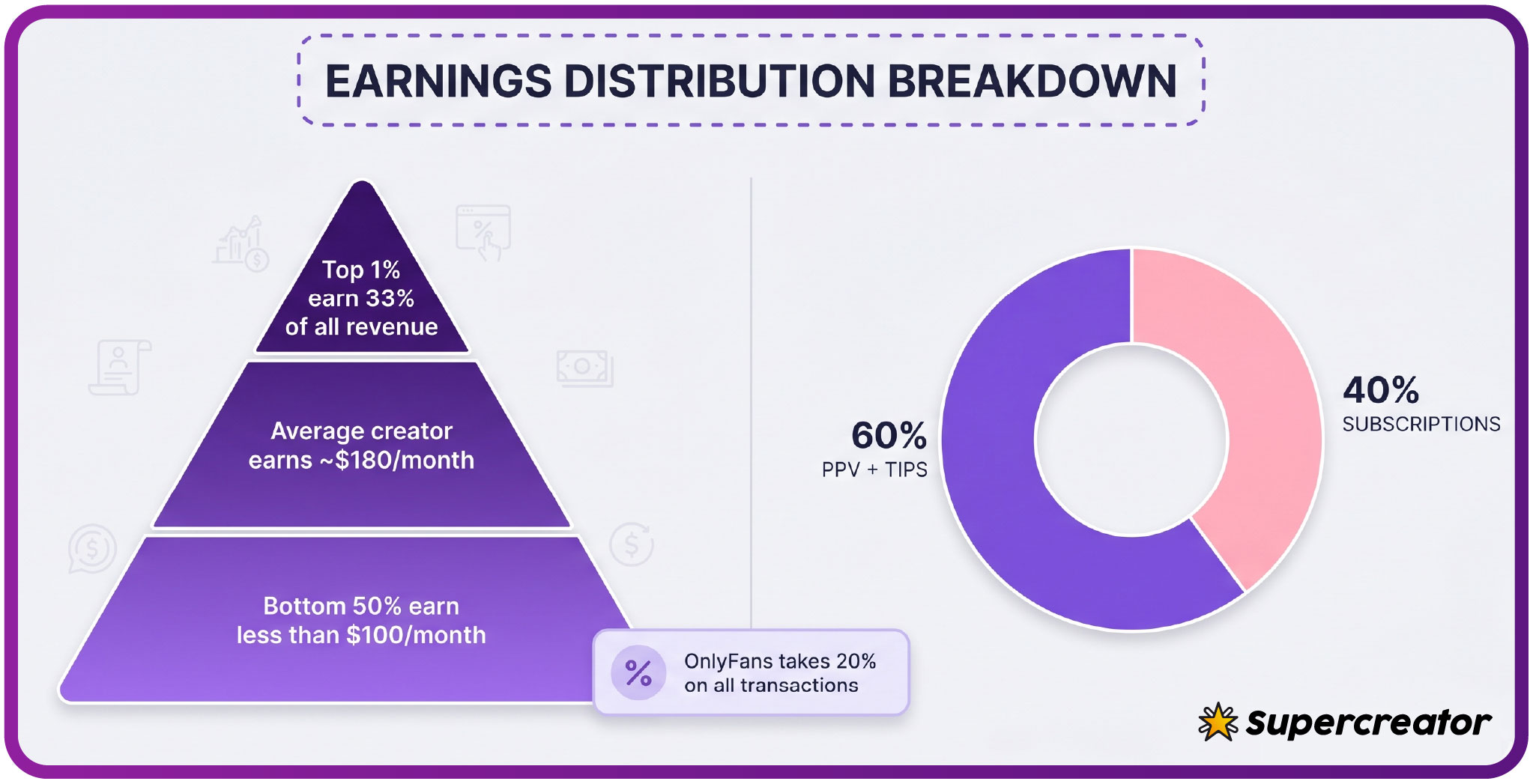
- The 20% platform fee applies to all of it, so the creator keeps 80% of each transaction just as on a paid page.
The difference is psychological rather than mathematical. A subscriber who would hesitate at a $9.99 monthly charge may accept a $0 entry and then spend $4 three times in a week without registering the total. Each individual decision feels small, which is exactly why the model works.
| Revenue Source | Creator Share | Platform Fee | Subscriber Visibility |
|---|---|---|---|
| PPV message unlock | 80% | 20% | Price shown before purchase |
| Tip on a post or message | 80% | 20% | Amount chosen by subscriber |
| Live stream tipping | 80% | 20% | Visible during the stream |
| Paid direct chat reply | 80% | 20% | Per-message price stated in advance |
Creators adopt this structure for reach. A free page can accumulate a large following quickly because there is no purchase decision at the point of entry. The trade-off is that revenue depends entirely on engagement quality, so message cadence and content pacing matter more than they do on a page with recurring income.
A card verification hold of $0.10 is standard when payment details are added. It is refunded within days and is not a charge for access. This trips up new subscribers who assume the free page has hidden costs before they have bought anything.
PPV Pricing Bands and Message Frequency Patterns
PPV pricing on free pages clusters into recognizable bands rather than a single flat rate. The platform ceiling for a single unlock sits near $50, and paid chat commonly runs $3 to $5 per message. Between those two poles, most content falls into predictable tiers based on length and exclusivity.
- Entry-level unlocks: $3 to $5, usually single images or short clips sent in a mass message.
- Mid-range content: $10 to $20, longer sets or bundles of several items.
- Premium material: $20 to $35, custom or specifically requested content.
- Maximum-tier unlocks: approaching the $50 platform ceiling, reserved for the most exclusive offers.
A single $5 unlock is trivial. Ten of them across a month is $50, which is more than most paid subscriptions cost. The cadence keeps the individual decision small while the cumulative total grows quietly.
Tip: before unlocking anything above $20, wait 24 hours. Most PPV offers remain available, and the pause separates genuine interest from the momentum of an active chat.
Message delivery patterns matter here too. Creators often send a teaser image with the locked item attached, so the subscriber sees exactly what they are declining. That preview is the strongest driver of conversion in the free-page model, which is why mass messaging volume tends to be higher here than on paid pages.
Access Boundaries Defining Free-Tier Experience
A $0 subscription is genuine access, but it is narrower than most people expect. The feed is visible, yet a large share of posts arrive with locked media attached. What the subscriber gets is the framing and the preview, not the payload.
- Feed posts are visible but frequently blurred or truncated behind a PPV lock.
- Direct messages can be received, but sending is typically restricted or priced per message.
- Live stream access is often excluded or requires a separate entry purchase.
- Story content is gated and expires whether or not it was unlocked.
- Archived posts stay unavailable unless each one is purchased individually.
The practical result is a page that feels open and closed at the same time. Subscribers who expect a free page to behave like a discount paid page usually unsubscribe within the first month once the pattern becomes clear.
A free page is free in price, not in process.
Spending Trajectory Patterns on Complimentary Tiers
It builds through phases, and each phase makes the next one feel more normal. Recognizing the sequence is the most useful budgeting skill a subscriber can develop.
- Phase one: a few cautious single unlocks, usually in the $3 to $5 band.
- Phase two: increasing message engagement as the creator responds and chat becomes routine.
- Phase three: bundle consideration, where several unlocks are purchased together.
- Phase four: monthly totals that can exceed what an equivalent paid subscription would have cost.
| Usage Pattern | Monthly PPV Count | Estimated Range | Paid Equivalent |
|---|---|---|---|
| Light | 2 to 4 unlocks | $10 to $20 | Comparable to a $5 to $10 subscription |
| Moderate | 6 to 10 unlocks | $30 to $60 | Above a typical $5 to $10 subscription |
| Heavy | 12 to 20 unlocks | $60 to $120 | Several times a paid subscription |
| Intensive | 20 or more unlocks | $120 and up | Well beyond any base subscription tier |
Paid subscriptions on the platform range from $4.99 at the minimum to $49.99 at the maximum, with most clustering between $5 and $10. Promotional first months can legitimately sit below $4.99, for example a $3 first month, but the base price itself cannot go under the minimum.
A moderate free-page user spending $40 a month is paying four times what a typical paid subscription costs, while receiving less overall.
Creator Conversion Tactics in Free-Page Environments
Free-page revenue depends on funnel design, and the funnel starts the moment someone subscribes. A welcome message with a low-priced unlock establishes that spending is normal on this page. From there, pricing escalates as trust builds.
Teaser placement is deliberate. Locked previews appear in the feed where they are unavoidable, while fully unlocked content is scarce enough to stay novel. Urgency does the rest: limited-time offers and expiring bundles compress the decision window.
The structure is simply optimized, which is why subscribers who treat a free page as casual browsing tend to spend more than they planned.
Budgeting Discipline for No-Subscription Access
Budgets fail on free pages because there is no recurring charge to anchor awareness. A PPV unlock does not announce itself as part of a pattern. The fix is to impose structure manually.
- Set a fixed monthly unlock count before subscribing, and treat it as a hard cap.
- Define a per-message price ceiling, for example nothing above $10 without a pause.
- Apply a 24-hour cooling period to any unlock priced above $20.
- Reconcile spending weekly rather than monthly, while the amounts are still small.
- Compare the running total against paid-page alternatives at the $5 to $10 range.
A simple ledger works better than memory. Log each unlock with a date and a price, and add tips and paid chat replies to the same sheet. Within two weeks the pattern becomes obvious, and the total is usually higher than the subscriber estimated.
It also helps to understand what happens when a creator raises a subscription price. That rule protects paid subscribers, but it does not apply to PPV, where each purchase is final.
Platform Discovery Limitations and External Solutions
There is no search page that surfaces creators by category, price, or PPV density. Finding a page usually means following a link from somewhere else entirely. That gap is why external ranking sites exist. A directory can categorize free-tier pages and flag how heavily each one relies on pay-per-view, so a visitor knows before subscribing whether the page is lightly monetized or message-heavy. Running a best onlyfans search through a directory that tracks these signals gives a clearer picture of likely spending than a page’s own description ever will.
This matters more on free pages than paid ones, because the cost is invisible until it accumulates. A free page states nothing, and the real number only appears after a month of unlocks. BestOnlyFans approaches this by scoring free-tier pages on PPV density, message frequency, and pricing consistency. That distinction is the single most useful piece of information a directory can provide for this access model.

External discovery also reduces exposure to scams. Pages that appear only through unsolicited direct messages, with no directory presence and no verifiable history, are a recurring source of payment fraud. Enabling two-factor authentication on the account and keeping payment details inside the platform removes most of that risk.
Free pages are not cheaper by default. They are cheaper at the door, and the rest depends entirely on how the subscriber behaves once inside.
FAQ
Can I follow a free OnlyFans page without any spending?
Yes. A $0 subscription gives access to the feed and incoming messages without any payment beyond the $0.10 card verification hold, which is refunded within days. Locked media stays locked unless purchased, so the page is followable at no cost but not fully viewable at no cost.
Why do creators run free pages if they earn less per fan?
Reach. Removing the entry price lets a page accumulate followers far faster than a paid one. Revenue then depends on PPV unlocks, tips, and paid chat, and the 80% creator share applies to each of those exactly as on a paid page.
How do I know how much I’ll spend on a free page before joining?
Check the page’s message frequency and typical unlock prices, and look for directory listings that flag PPV density. If a page sends frequent locked messages in the $5 to $20 range, a moderate month can easily reach $40 or more, which exceeds most paid subscriptions.
Are PPV messages on free pages more expensive than paid page extras?
Pricing bands are broadly similar across both page types, with paid chat commonly at $3 to $5 per message and unlocks ranging from $3 up to the $50 platform ceiling. The difference is volume. Free pages tend to send more locked messages because there is no subscription income covering the gap.